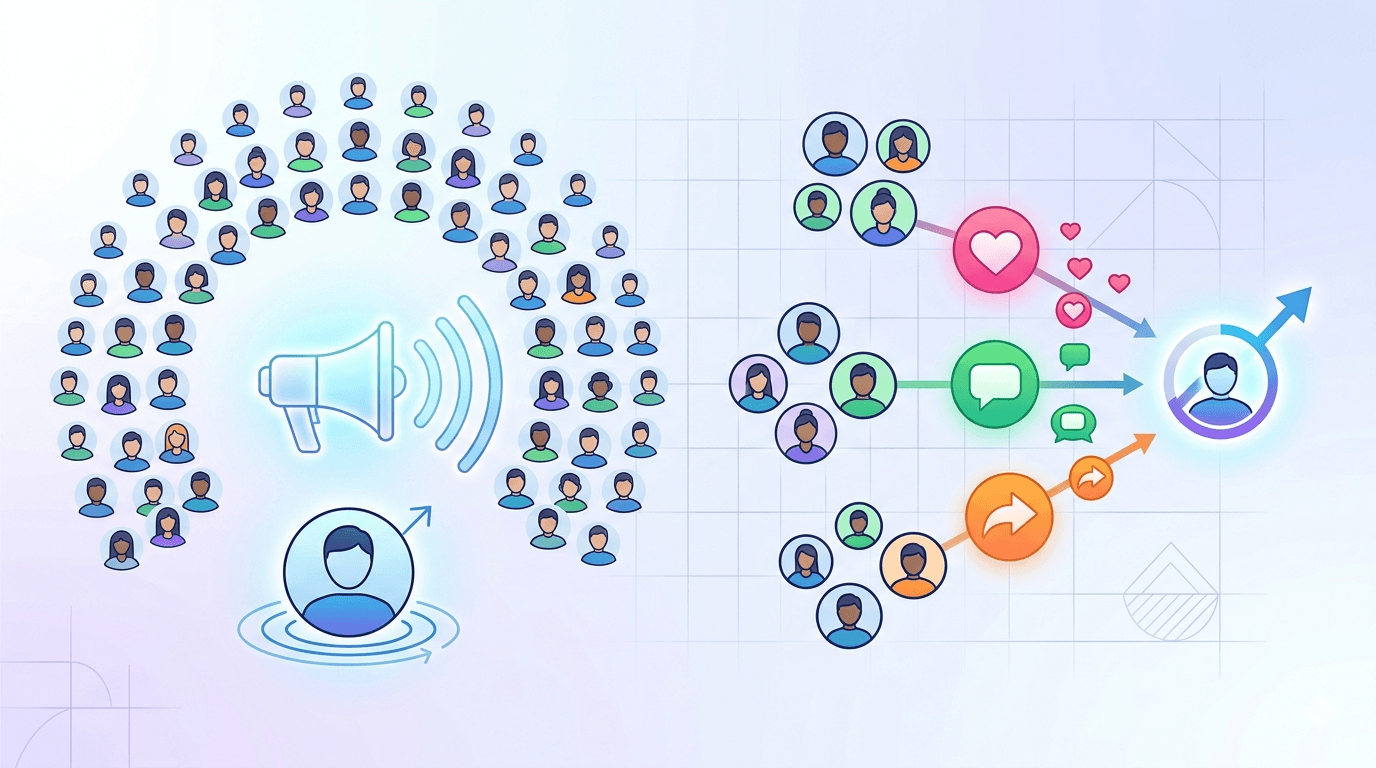
Reach tells you how many people saw your content. Engagement rate tells you whether those views meant anything. Both numbers live in every analytics dashboard, yet most creators and marketers treat them as interchangeable, and that mistake quietly undermines their strategy.
Understanding the difference between engagement rate and reach is not an academic exercise. It changes which content you make more of, which campaigns you scale, and whether your growth is actually working or just looking like it is. This article breaks down both metrics completely, covers every formula you need, and answers the question most guides avoid: which one should you actually prioritize?
What Is Reach?
Reach is the total number of unique accounts that saw your content during a given period. If 5,000 different people saw your post, your reach is 5,000. Simple.
A few important distinctions worth keeping straight:
- Reach counts unique viewers once, no matter how many times they saw the post.
- Impressions count every view, including repeat views from the same person.
- A post can have 10,000 impressions but only 6,000 reach if some people saw it multiple times.
Reach is primarily an awareness metric. It tells you the size of your potential audience for a piece of content. High reach means your content traveled. It does not mean your content connected.
What Is Engagement Rate?
Engagement rate measures how actively your audience interacted with your content relative to its exposure. Interactions typically include likes, comments, shares, saves, and clicks, depending on the platform.
Engagement rate meaning in plain terms: it is the percentage of people who did something when they saw your content, rather than scrolling past.
This is a quality metric. A post with 200 genuine comments and 500 shares is performing better than a post with 50,000 reach and 40 likes, even if the second post “went further.”
Engagement rate is the clearest signal you have that your content is actually resonating, not just appearing.
Engagement Rate vs Reach: Key Differences
| Factor | Reach | Engagement Rate |
|---|---|---|
| What it measures | Unique viewers | Audience interaction as a % |
| Type of metric | Quantity / Awareness | Quality / Connection |
| What it signals | Distribution | Resonance |
| Best used for | Awareness campaigns | Content quality analysis |
| Can be inflated by | Paid promotion, virality | Nothing — low quality shows immediately |
| Platform visibility impact | Algorithm rewards high reach | Algorithm rewards high engagement |
The most important thing this table shows: reach can be bought or boosted with distribution. Engagement rate is much harder to fake sustainably, which is exactly why algorithms trust it more.
How to Calculate Engagement Rate
There are three main formulas, and using the wrong one gives you a misleading number.
Engagement Rate by Followers
This is the most common formula and the one most benchmarks are based on.
Formula: (Total Engagements ÷ Total Followers) × 100
Example: 800 engagements on a post, 20,000 followers = 4% engagement rate.
Use this for: comparing your performance over time, evaluating your account health.
Engagement Rate by Reach
This formula is more accurate for individual post performance because it accounts for how many people actually saw the post.
Formula: (Total Engagements ÷ Post Reach) × 100
Example: 800 engagements, 12,000 reached = 6.67% engagement rate by reach.
Use this for: understanding whether the people who saw a post responded to it.
Engagement Rate by Impressions
Formula: (Total Engagements ÷ Total Impressions) × 100
This gives you the lowest percentage of the three because impressions are always higher than reach. It is useful for paid campaign analysis where you are paying per impression.
Which formula should you use? For organic content analysis, engagement rate by reach is the most honest number. For account-level health, use engagement rate by followers. For paid campaigns, use impressions.
Why High Reach Does Not Always Mean High Engagement
This is one of the most misunderstood dynamics in social media, and it costs creators real growth.
When a post goes viral or gets pushed by the algorithm to a cold audience, reach spikes dramatically. But that new audience has no relationship with you. They have no reason to comment, save, or share. So while reach goes up, engagement rate often drops.
Common reasons for high reach with low engagement:
- Content was boosted to audiences with no prior interest in your niche
- A trending audio or hashtag drove views from unrelated accounts
- The post was reshared outside your core community
- Your content captured attention but did not prompt a response (weak hook, no CTA, poor relevance)
A post with 100,000 reach and 0.3% engagement is underperforming. A post with 4,000 reach and 8% engagement is a strong signal your core audience genuinely connects with what you made.
This is also why buying cheap followers quietly destroys your reach over time. A large follower count with zero engagement activity sends the algorithm clear signals that something is wrong.
Which Metric Matters More for Brands, Influencers, and Businesses?
There is no universal answer. The right metric depends on what you are trying to accomplish.
Awareness Campaigns
If you are launching a new product, promoting an event, or trying to enter a new market, reach is your primary KPI. You want as many relevant people as possible to see your message. Engagement matters less here, though a complete absence of it is still a red flag.
Conversion Campaigns
When your goal is sales, sign-ups, or direct action, engagement rate becomes far more important. A smaller, highly engaged audience converts at a much higher rate than a massive passive one. This is the foundation of niche marketing.
Influencer Marketing
For brands evaluating influencers, engagement rate by reach is the most important number to check. A creator with 500,000 followers and a 0.5% engagement rate will likely underperform compared to one with 80,000 followers and a 6% rate. Reach impresses at first glance. Engagement rate predicts results.
Organic Growth
For anyone building a presence from scratch, prioritize engagement rate in the early stages. The algorithm on every major platform uses engagement signals to decide whether to expand your reach organically. You earn reach by demonstrating that your audience responds to your content.
If you are growing a new Instagram account from zero, focusing on engagement quality before chasing reach is one of the most important strategic decisions you can make.
Reach vs Impressions vs Engagement
These three terms appear together constantly and the confusion between them is legitimate.
Reach = unique people who saw your content (counted once per person)
Impressions = total number of times your content was displayed (includes repeat views)
Engagement = actions taken on the content (likes, comments, shares, saves, clicks)
A single person can account for 5 impressions but only 1 unit of reach. That same person can contribute 2 engagements if they liked and saved the post.
Why this matters practically: If your impressions are much higher than your reach, your content is being seen multiple times by the same people. That can indicate strong relevance for a loyal audience, or it can mean your distribution is narrow and you are not reaching new users at all. Context determines which.
What Is a Good Engagement Rate?
Benchmarks vary by platform, audience size, and content type. Larger accounts almost always have lower engagement rates because the relationship between creator and follower becomes less personal at scale.
Instagram Engagement Rate Benchmarks (2026)
| Account Size | Good Engagement Rate |
|---|---|
| Nano (1K–10K) | 5% – 10%+ |
| Micro (10K–100K) | 2% – 5% |
| Mid-tier (100K–500K) | 1.5% – 3% |
| Macro (500K–1M+) | 0.5% – 1.5% |
TikTok Engagement Rate Benchmarks
TikTok generally sees higher engagement rates than Instagram due to its algorithm actively pushing content to new audiences. A 4%–8% engagement rate is solid for most creators. Anything above 10% is exceptional.
LinkedIn Engagement Rate Benchmarks
LinkedIn is a lower-engagement environment overall. A rate of 2%–5% is considered strong. Text posts tend to outperform video on LinkedIn, which is the opposite of most other platforms.
These benchmarks are calculated by followers. If you are calculating by reach, expect your percentage to be higher since reach is typically smaller than your total follower count.
How to Improve Reach and Engagement Together
Growing both metrics simultaneously is possible, but it requires treating them as related outcomes of content quality rather than independent levers to pull.
To increase reach:
- Post consistently so the algorithm treats your account as active. Knowing the best posting times for each platform gives you a compounding advantage.
- Use relevant hashtags and keywords in captions, especially on Instagram and TikTok.
- Create content formats the platform is currently favoring (Reels, short-form video, carousels).
- Collaborate with other creators to tap into their audiences.
To increase engagement rate:
- Open with a strong hook. The first three seconds of a video and the first line of a caption determine whether people stop. Strong short-form video hooks dramatically impact completion and interaction rates.
- Ask a specific question at the end of your caption. Vague calls to action produce no response.
- Create content around topics your audience already cares deeply about, not just topics that are trending.
- Reply to every comment in your first hour after posting. Early engagement signals boost algorithmic distribution.
- Post at times when your audience is most active.
The compounding effect: When your engagement rate is high, platforms expand your reach organically. When your reach grows, more potential engaged followers find you. The two metrics are not in competition, they feed each other when your content earns both.
FAQs
These are the questions that come up most often when people start digging into social media analytics.
Is reach more important than engagement?
It depends on your goal. For awareness and discovery, reach matters most. For building a loyal, converting audience, engagement rate is the more valuable signal. Most serious growth strategies prioritize engagement early and let reach follow.
Does engagement increase reach?
Yes, significantly. On Instagram, TikTok, YouTube, and most other platforms, the algorithm uses early engagement signals to decide how broadly to distribute content. A post that generates fast comments, shares, and saves in the first hour is far more likely to be shown to a wider audience.
What is a good engagement rate by reach?
Generally, anything above 5% by reach is strong for most niches. Highly engaged communities in specific niches (fitness, personal finance, parenting) can see 10%–20% by reach. Below 2% by reach suggests the content is not resonating with those who see it.
Why do some viral posts have low engagement rates?
Virality often means wide distribution to cold audiences who have no prior connection to the creator. Those viewers are less likely to interact. A post can rack up millions of views from passive scrollers while maintaining a 0.2% engagement rate. High reach alone does not equal meaningful performance.
What is the difference between reach and impressions in practical terms?
If 1,000 unique people saw your post but some of them saw it 3 times each, you might have 1,000 reach and 2,400 impressions. Reach counts who saw it. Impressions count how many times it was seen. For measuring genuine audience size, reach is the more useful number.
Conclusion
Engagement rate and reach measure two fundamentally different things. Reach tells you how far your content traveled. Engagement rate tells you whether it was worth the trip. Treating either metric in isolation leads to bad decisions, whether that means scaling distribution for content nobody responds to or obsessing over engagement while remaining invisible to new audiences.
The most effective approach is to use them together. Build content that earns genuine engagement, and use that engagement as the fuel for organic reach. Track both, but weight them according to your actual goal at each stage of your strategy.
Start by auditing your last 10 posts with both metrics in mind. If your reach is high but engagement rate is consistently below 1%, your content is reaching the wrong people or failing to prompt a response. If your engagement rate is strong but reach has plateaued, your distribution strategy needs work. Either way, the numbers are already pointing you toward the fix.