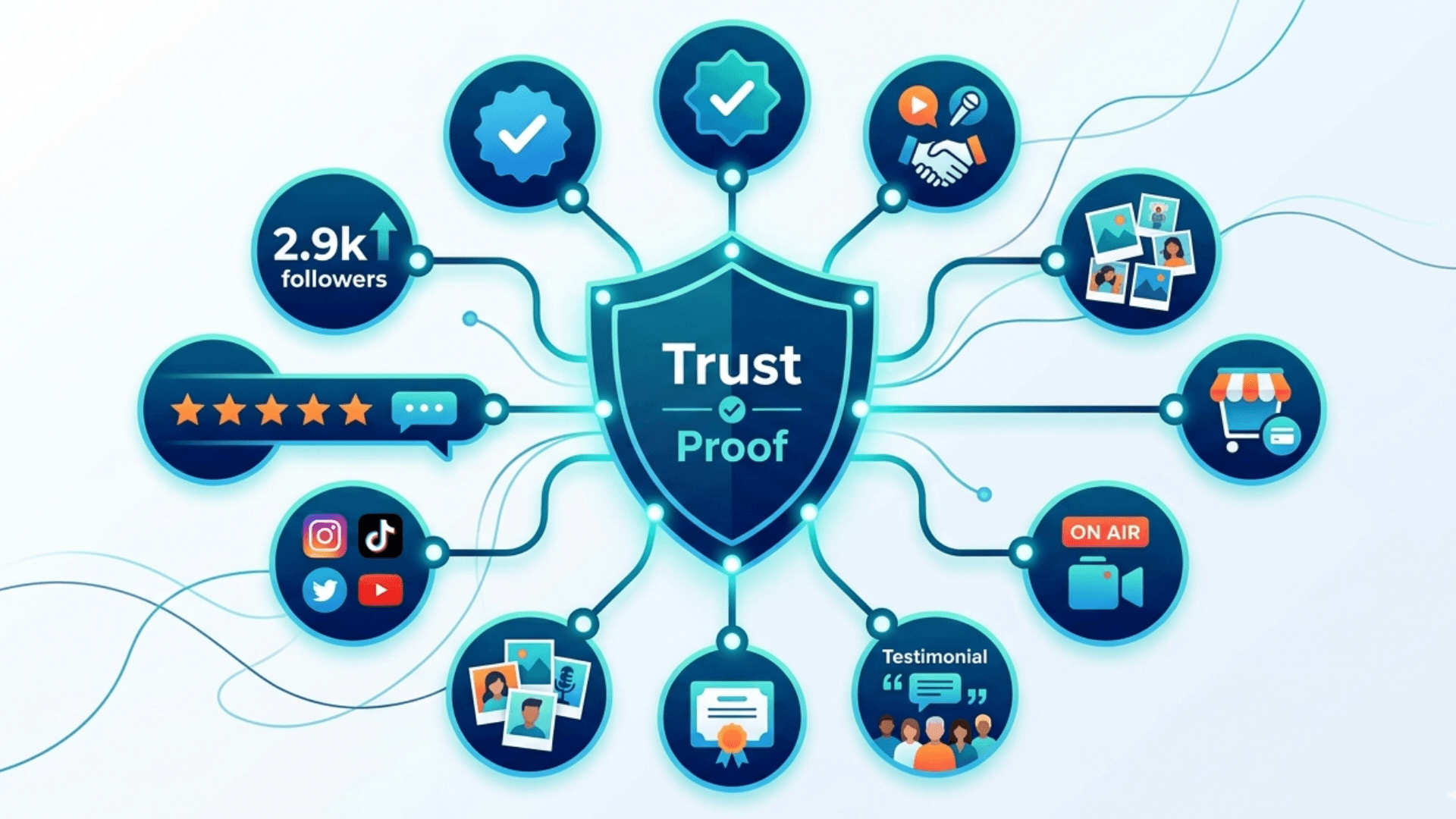
Social proof is the single biggest reason someone buys from one creator and ignores another with nearly identical content. When a potential customer lands on your profile or sales page, they are not evaluating your offer first. They are scanning for evidence that other people already trust you. That mental shortcut drives most purchase decisions online, and it works the same whether you have 500 followers or 500,000.
The good news is that you do not need a massive audience to build strong social proof. Most creators misunderstand this. They assume that low follower counts or minimal engagement automatically signal low credibility. That is not true if you actively display the right trust signals. Social proof for creators is less about raw numbers and more about strategic visibility of trust.
This post covers 11 specific, actionable trust signals you can build and display right now to increase credibility and move followers toward buying decisions. These tactics work at every stage, and several are especially powerful for small or beginner creators who are starting from a quiet profile.
Why Social Proof Matters More Now Than Ever
Attention is cheap. Trust is expensive. In 2026, the creator economy is more crowded than it has ever been, and audiences have become sharper at filtering out creators who feel unverified or unproven.
The psychological principle behind social proof is simple. When people are uncertain, they look at what others are doing to decide what they should do. Robert Cialdini documented this in Influence decades ago, and digital behavior has only amplified it. A buyer who hesitates on a $47 course will push past that hesitation the moment they see that 300 other people already purchased it.
For creators specifically, trust signals need to appear at multiple touchpoints. That includes your social profiles, your content, your website or link-in-bio, and your email list. The creators who convert best are not always the ones with the most reach. They are the ones who make it impossible for a visitor to doubt their credibility.
11 Trust Signals That Build Social Proof as a Creator
1. Testimonials With Specifics, Not Vague Praise
Generic testimonials do almost nothing. “This course changed my life” is easy to dismiss. “I landed my first client three weeks after going through Module 4” is not.
Ask past students, clients, or customers for feedback that includes a concrete result, a timeframe, and a before-and-after detail. Screen captures of real messages work well here. Text over a plain background with the person’s name and photo performs even better.
Place testimonials directly on your sales page near the price or call to action. That is where doubt peaks, so that is where social proof should appear.
2. Visible Engagement on Your Content
Low engagement is a silent trust killer. When someone visits your profile and sees posts with minimal likes, comments, or shares, their brain interprets that as a signal that your content is not valued by others.
Strong engagement does the opposite. It tells the visitor that real people are paying attention, responding, and finding value. This is one reason why growing a consistent, engaged audience matters beyond just vanity metrics. Engagement functions as live social proof every time someone lands on your profile.
If your engagement is currently low, prioritize content formats that invite responses. Ask specific questions in captions, use polls and sliders in stories, and reply to every comment in the early hours after posting. The algorithm rewards it and so does human perception.
3. User-Generated Content and Reshares
When someone else posts about your product, your content, or your advice without being asked, that is one of the most powerful forms of social proof available. It signals unprompted endorsement.
Actively collect this. Create a branded hashtag. Ask buyers to share their results. Reshare or screenshot UGC to your stories and save it in a highlight. A “Results” or “Community” story highlight that fills up over time compounds into a strong ongoing trust signal for every new visitor.
4. Featured Media Mentions or Collaborations
Being featured in a newsletter, podcast, YouTube video, blog, or even a notable creator’s story immediately raises your perceived authority. This is borrowed credibility and it works even at small scales.
You do not need a Forbes feature. A mention from a respected creator in your niche, a guest spot on a podcast your audience listens to, or a co-post with someone who has a complementary following all count. Once you have those mentions, display them. Create a simple “As seen in” or “Featured on” section on your link page or website.
5. Milestone Numbers That Signal Movement
Numbers are concrete and scannable. “2,400 students enrolled,” “12,000 newsletter subscribers,” or “over 800 coaching clients served” all communicate that people have already chosen to trust you.
Even smaller numbers carry weight if framed well. “Join 340 creators who already downloaded this free guide” is specific and believable. Specificity signals authenticity. Round numbers like “thousands of students” actually feel less credible because they look estimated.
Track and display these numbers anywhere a new visitor makes a decision. Update them regularly so they reflect reality.
6. Consistency of Presence Over Time
Longevity is underrated as a trust signal. A creator who has been producing consistent content for 18 months reads as more reliable than someone who just appeared. Audiences and potential buyers are quietly noting this.
This is one reason why avoiding burnout and maintaining a sustainable schedule is not just a wellness topic. It is a credibility strategy. Gaps in content history create subtle doubt about reliability.
Pin older content that performed well so new visitors can see a track record. Your archive of useful content proves that your value is not a one-time thing.
7. A Clear Creator Bio That Signals Specific Expertise
Your bio is often the first social proof signal a visitor encounters. Vague bios like “content creator, coach, entrepreneur” say everything and nothing. Specific bios build faster trust.
Compare these two versions:
- “I help people grow online.”
- “I help freelance designers get their first three retainer clients using short-form video.”
The second immediately signals that you have thought deeply about a specific problem for a specific person. That focus reads as expertise, and expertise is a form of credibility.
8. Case Studies, Before-and-After Stories
Case studies are longer testimonials with structure. They document a person’s starting point, the specific approach taken, and the measurable outcome. They are particularly effective for selling coaching, courses, or consulting.
Even one well-documented case study can dramatically improve conversions. It does not need to be polished. A simple written or video walkthrough of how a client went from problem to result is enough. Publish it on your website and link to it from your sales page.
9. Social Media Follower and Subscriber Counts (When They Are Respectable)
Follower counts are a blunt instrument but they still matter as a first impression. A profile with 12,000 engaged followers is perceived as more credible than one with 800 regardless of content quality. This is the reality of how new visitors scan profiles.
The implication is straightforward. Early-stage growth is not just about reach. It is about building the perception of authority so that trust signals compound over time. A growing, active social presence removes a subconscious objection before the visitor even reads your content.
10. Transparent Personal Results and Documented Proof
Showing your own results is a form of social proof that many creators avoid out of modesty or fear. That is a mistake. If you teach email marketing, show your open rates. If you coach fitness, document your own transformation. If you help people monetize content, show your own revenue milestones.
This kind of proof is especially powerful because it removes the biggest unspoken objection: “Does this person actually do what they teach?” You do not need to overshare. You need to show enough that the answer is clearly yes.
11. Reviews and Ratings on External Platforms
Third-party validation carries more weight than self-reported testimonials because the audience knows you cannot control it. Reviews on platforms like Google, Trustpilot, Amazon (for books), Gumroad, or Udemy all function as independent credibility signals.
If you sell digital products, encourage buyers to leave a review on the platform. A product with 47 reviews and a 4.8-star rating converts significantly better than the same product with no reviews, even if the content is identical. Getting those first 10 to 20 reviews should be a priority for any new launch.
How to Combine Trust Signals Strategically
Individual trust signals help. Combined, they create a credibility ecosystem that is hard to compete with.
Think about the journey a potential buyer takes before purchasing. They might see your content, visit your profile, click your link in bio, land on your sales page, and hesitate at the price. Each of those touchpoints is an opportunity to reinforce trust.
Map out that journey and ask where doubt peaks. Then place the most relevant trust signal at each point. Engagement on your content handles the profile visit. Testimonials handle the sales page hesitation. A featured mention handles the “Is this person legit?” question. UGC handles the “Do real people use this?” question.
Social proof is not a single asset. It is a system of signals placed at every decision point along the path to purchase.
For creators who are newer or working with smaller audiences, this strategic layering matters even more. You may not have big numbers yet, but you can have specificity, transparency, and consistent visible proof that your work produces results.
If you are still building your foundation, understanding what to set up before you launch publicly can prevent a lot of wasted effort. Starting with the right structure makes every trust signal you build later more effective.
Social Proof for Faceless or Anonymous Creators
Many creators assume social proof requires a personal brand with a visible face. That is not true. Faceless creators can still build strong credibility using several of the signals above.
Focus heavily on documented outcomes. Screenshots of results from your audience, engagement metrics, sales numbers, and external reviews all carry weight without requiring a personal photo. A well-maintained, consistent posting presence still signals reliability. Niche authority can come through content quality and depth rather than personality.
What faceless creators need to be especially deliberate about is removing ambiguity. A faceless profile with vague messaging and no visible results will struggle. The same profile with clear results, specific numbers, and strong UGC can convert well.
Beginner Creator? Start With These Three
If you are just getting started, you probably cannot deploy all 11 signals immediately. That is fine. Prioritize in this order.
- First: Build your bio into a specific expertise signal. It costs nothing and works immediately.
- Second: Collect your first three to five testimonials or documented results as fast as possible, even from free beta users.
- Third: Focus hard on engagement quality over follower volume. Ten genuine comments on a post do more for trust perception than 1,000 followers who never interact.
Those three signals alone put you ahead of most beginner creators who are still waiting until they “have something to show.”
FAQ
Can small creators use social proof effectively without a large following?
Yes, and many do. Social proof is not just about follower counts. Specific testimonials, documented results, consistent engagement, and a clear bio all build trust before numbers are impressive. The key is being intentional. Do not wait until you have a big audience to start collecting and displaying proof.
What is the fastest way to get testimonials as a new creator?
Offer something free or at a reduced rate in exchange for detailed feedback. This could be a beta version of your course, a free coaching call, or early access to a digital product. Ask for feedback that includes a specific outcome or result, not just general praise. Those first five testimonials, even from unpaid users, are worth more than you might think.
How does engagement affect social proof on social media?
Engagement is live, visible social proof. When a new visitor sees your posts generating genuine comments and shares, that signals value without them needing to read a single word of copy. Weak engagement, conversely, can undermine even strong written testimonials. Growing and maintaining active engagement is one of the highest-leverage credibility investments you can make.
Do follower counts still matter for creator credibility in 2026?
They still function as a fast heuristic during a first impression, but they have become less decisive as audiences have grown more skeptical of inflated numbers. What matters more now is the ratio of engagement to followers and whether the account shows consistent activity. A smaller, visibly engaged audience often reads as more credible than a large, quiet one.
Should I display negative reviews or only positive ones?
Showing only positive reviews is expected and does not hurt you. However, responding publicly to a rare critical piece of feedback and demonstrating how you resolved it actually builds trust. It signals that you are accountable and that your positive reviews are real. Selectively curate, but do not fear imperfection.
Conclusion
Social proof is not a feature you add after you build an audience. It is something you build alongside your audience, starting from the first post. The creators who convert followers into customers most reliably are the ones who treat every testimonial, every engagement signal, and every external mention as a trust asset worth collecting and displaying.
You do not need to implement all 11 signals at once. Start with the ones that match your current stage, be consistent with them, and let your credibility compound over time. Even a single detailed case study or a genuinely engaged comment section does meaningful work in the mind of a potential buyer who is deciding whether to trust you.
The next step is simple. Audit your current presence and identify where your biggest trust gaps are. Is it your bio, your engagement levels, your testimonials, or your results visibility? Pick the weakest point and address it this week. Small, specific improvements in social proof have a disproportionate impact on conversions, and the work you do now will pay dividends every time someone new discovers your content.