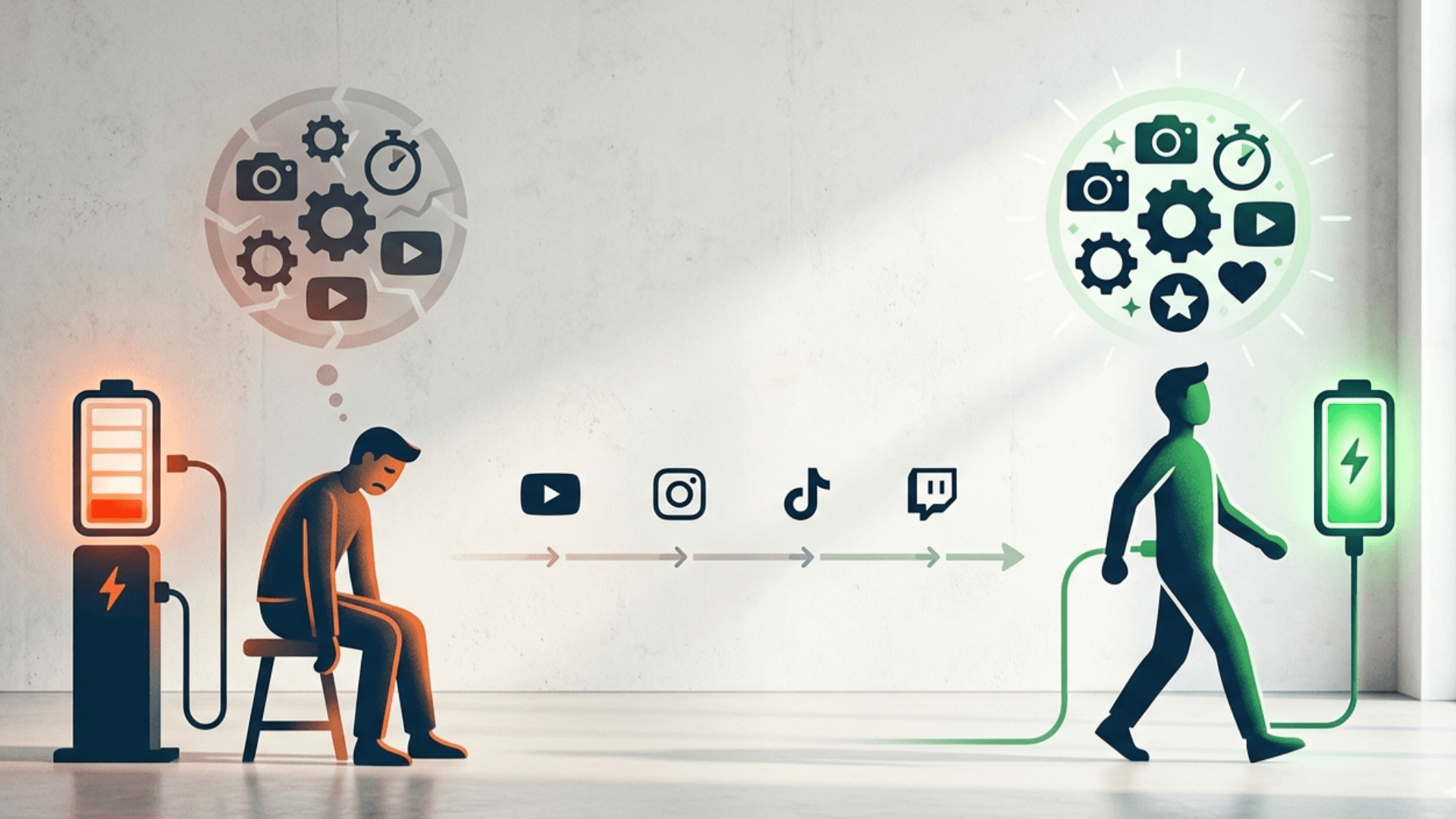
Creator burnout is not a willpower problem. It is what happens when output demands consistently outpace recovery, and most creators hit it long before they realize what is wrong. You start missing posting days, dread opening the app, or find that editing a single video feels like climbing a wall. That is not laziness. That is your system breaking down.
The irony is that the creators most at risk of burnout are often the most driven. They push hard, post relentlessly, and chase every algorithm shift, until the momentum they built quietly collapses. Understanding how to avoid creator burnout means understanding why high-output without structure eventually fails, and what to replace it with.
This guide gives you a practical, sustainable framework. You will learn how to restructure your workflow, protect your creative energy, batch smarter, and build the kind of consistency that compounds over months and years, not just a few hot weeks.
What Creator Burnout Actually Looks Like
Burnout rarely arrives as a dramatic breakdown. More often it builds slowly, disguised as procrastination or declining motivation.
The most common signs include a drop in posting frequency despite clear intentions to stay consistent, a loss of excitement about ideas that used to energize you, increasing irritability around content tasks, and a growing feeling that nothing you make is good enough. Some creators describe it as the work feeling “hollow,” even when performance metrics are fine.
The platform pressure is real. Social media rewards volume and consistency, so any slowdown tends to trigger anxiety about losing momentum, visibility, or audience trust. That anxiety often pushes creators to keep grinding through burnout instead of addressing it, which makes recovery take longer.
Recognizing the signs early matters because early-stage burnout is far easier to reverse than late-stage exhaustion. A short, intentional reset is always better than an involuntary six-week disappearance.
Why Most “Post Every Day” Advice Backfires
Consistency advice in the creator space almost always focuses on output frequency. Post daily. Never miss a day. Stay top of mind.
The problem is that frequency without structure is just a faster path to depletion. A creator who posts every day by grinding through weekends, skipping hobbies, and sacrificing sleep is not building a sustainable channel. They are scheduling their own burnout.
Consistency is not about how often you post. It is about how long you can keep posting without falling apart.
Research on cognitive performance consistently shows that creative output quality declines significantly with fatigue. In practical terms, this means a creator running on empty produces weaker content that is less likely to connect with an audience, despite the effort it takes to produce it. Volume without recovery is a losing trade.
Sustainable consistency requires building systems that account for human limits, not systems that pretend those limits do not exist.
Build a Content System, Not Just a Schedule
A content schedule tells you when to post. A content system tells you how to keep posting without exhausting yourself.
The difference matters enormously. Creators who rely on schedules alone tend to scramble before every deadline. Creators with systems have a pipeline of ideas, partially processed drafts, and batched production that separates thinking from creating.
The Core Components of a Sustainable System
- Idea capture: Keep one dedicated place for raw ideas, whether that is a notes app, a voice memo folder, or a simple spreadsheet. The goal is to stop relying on inspiration to arrive on demand. Collect ideas passively throughout the week, then evaluate them during a short weekly review session.
- Content pillars: Define three to five core topic areas that align with your niche and your audience’s interests. Every piece of content should trace back to one of these pillars. This eliminates the paralysis of open-ended ideation and keeps your output coherent, which matters a great deal for how your audience perceives your expertise and consistency.
- Batching: Group similar tasks together instead of running through every production stage for each piece individually. Record three videos in one session, edit them in another, and schedule them all at once. Batching reduces context-switching costs, which is one of the biggest hidden drains on creative energy.
- Buffer content: Always have at least two to three pieces of completed content ready to publish but not yet posted. This buffer is your insurance against sick days, creative dry spells, or unexpected life events. Without it, any disruption immediately becomes a consistency gap.
Set Creative Boundaries Without Feeling Guilty
One of the most overlooked factors in creator burnout is the absence of boundaries around work hours, response expectations, and off-time.
Many creators treat content creation as a lifestyle rather than a professional activity with defined hours. The phone is always nearby. Ideas are always being processed. Comments are always being read. The mind never fully detaches from “creator mode,” which means recovery never actually happens.
Practical boundaries that work:
- Set specific creation windows and protect them. Outside those windows, you are not working on content.
- Batch your community engagement into a short daily window instead of checking comments continuously throughout the day.
- Designate at least one full day per week where you do not create, edit, or plan content at all.
- Create an “ideas quarantine” folder where incoming thoughts go but are not acted on immediately. Review it weekly, not hourly.
The guilt that comes with taking breaks usually stems from a belief that downtime equals falling behind. That belief is incorrect. Rest is when creative capacity regenerates. Creators who build genuine rest into their schedules consistently outperform those who treat rest as a reward for hitting targets.
Manage the Algorithm Anxiety That Drains You
Most creators carry a low-grade, constant anxiety about algorithmic performance. A video underperforms and the spiral begins. What went wrong. Did the algorithm change. Is the account being suppressed. Should the posting time be different.
This kind of anxious analysis is exhausting and, more often than not, it leads to over-correction. Creators start chasing trends that do not align with their niche, posting in formats they dislike, and abandoning content strategies that were actually working.
If you have ever wondered whether your reach is being artificially limited, it is worth understanding how platform mechanics actually work. For Instagram creators specifically, issues like reach suppression and algorithm treatment of newer versus established accounts can explain performance dips that have nothing to do with your content quality.
The healthier response to algorithm anxiety is to separate what you can control from what you cannot. You can control content quality, posting consistency, audience engagement, and your own energy. You cannot control platform mechanics directly. Focusing most of your attention on the controllables reduces anxiety and produces better outcomes.
Rethink Your Content Goals to Protect Motivation
Burnout often accelerates when the goals driving your content creation stop feeling meaningful. Chasing follower counts, view milestones, or engagement rates as primary motivations is fragile because those metrics fluctuate and are partly outside your control.
More durable motivation comes from process goals and impact goals. Process goals focus on the quality of your work and how well you are improving. Impact goals focus on the value you deliver to a specific audience. Both give you a sense of progress even during slow growth periods.
When a number stops going up, process and impact goals keep you moving forward.
It also helps to periodically reconnect with why you started creating in the first place. That original motivation, stripped of metrics and performance pressure, usually contains something genuine that can re-anchor your work during low-energy stretches.
Recovery Strategies When Burnout Has Already Hit
If you are reading this after burnout has already set in, here is what the recovery process actually looks like.
- Step one is stopping the bleed. Do not try to push through. If you have a content buffer, use it and take a real break. If you do not, communicate honestly with your audience. Most audiences are far more forgiving of a genuine hiatus than creators expect.
- Step two is identifying what broke down. Was it volume, pace, lack of systems, external pressure, or a loss of meaning? The answer shapes the fix. Returning to the same setup that caused burnout will produce the same result.
- Step three is rebuilding at a lower volume. Come back posting less than you were before, not more. Your goal during recovery is to re-establish enjoyment and momentum, not to make up for lost time. Many creators who try to compensate for a hiatus with a sudden surge end up burning out again within weeks.
If you are starting a channel fresh or rebuilding after a break, the foundation you set early shapes how sustainable everything that follows will be. Getting the structural decisions right from the start matters more than posting volume.
The Long Game: Consistency That Compounds
Creators who last five, seven, ten years are not the ones who hustled hardest in year one. They are the ones who built systems that made sustainable output possible and who treated their creative energy as a resource worth managing.
The compounding effect of consistent, quality content is real. A library of 200 videos built over three years, from a healthy and sustainable pace, will almost always outperform a library of 400 videos built in one chaotic, burned-out year. Platform algorithms reward consistent engagement signals, and audiences trust creators who show up reliably more than those who sprint and disappear.
Growing a platform long-term requires a combination of strategic consistency and audience trust. Neither of those things can be rushed or faked, and both collapse when burnout is left unaddressed.
Build for the version of yourself who will still be creating in three years. That creator needs a workflow that leaves room for rest, creative curiosity, and a life outside the content.
FAQ
These are the questions creators ask most often when dealing with burnout or trying to prevent it.
Is it normal to lose motivation after a period of fast growth?
Yes, and it is more common than most creators admit. A fast-growth phase often involves an unsustainable pace. When growth slows or plateaus, the high-effort routine suddenly feels unrewarded. This is a natural psychological response, not a sign that something is wrong with you or your content. The key is to reassess your effort-to-output ratio and re-align it with a pace you can maintain indefinitely.
How do I stay consistent when I have no inspiration?
Consistency should never depend on inspiration. Inspiration is unreliable. Systems are not. If you have content pillars defined, a backlog of ideas, and batched production in place, uninspired days become non-events rather than crises. The work gets done because the structure makes it routine, not because you felt energized.
How often should I take breaks from creating?
At minimum, one full rest day per week is a reasonable baseline. Beyond that, a short planned hiatus of two to four days every six to eight weeks can prevent the deep depletion that leads to extended burnout. These breaks work best when they are scheduled proactively, not taken reactively after you have already hit a wall.
Should I tell my audience when I am taking a break?
Generally yes, especially if you have an engaged audience that posts on a predictable schedule. A brief, honest post explaining you are stepping back for a short reset tends to earn goodwill rather than lose it. You do not need to overshare. A simple acknowledgment that you are taking intentional time off is enough.
Can a smaller posting volume still produce real growth?
Absolutely. Posting three high-quality, well-targeted pieces of content per week will consistently outperform posting seven mediocre ones. Quality and relevance drive the engagement signals that matter most to platform algorithms and to actual audience growth. A smaller, sustainable volume made from a healthy creative state is a stronger long-term strategy than maximum output made from depletion.
Conclusion
Avoiding creator burnout is not about working less. It is about working in a way that you can sustain without breaking down. The creators who build lasting platforms are the ones who treat their creative energy with the same strategic thinking they apply to their content.
Start by building a system instead of just a schedule. Add a content buffer, batch your production, define your pillars, and protect your rest time as seriously as you protect your posting calendar. If burnout has already arrived, recover at a lower volume and fix the structure that caused the problem before ramping back up.
The long game belongs to creators who show up consistently, not those who sprint the hardest. Audit your current workflow this week and identify one system change that reduces your daily creative friction. That single shift, applied consistently, is where sustainable growth actually starts.