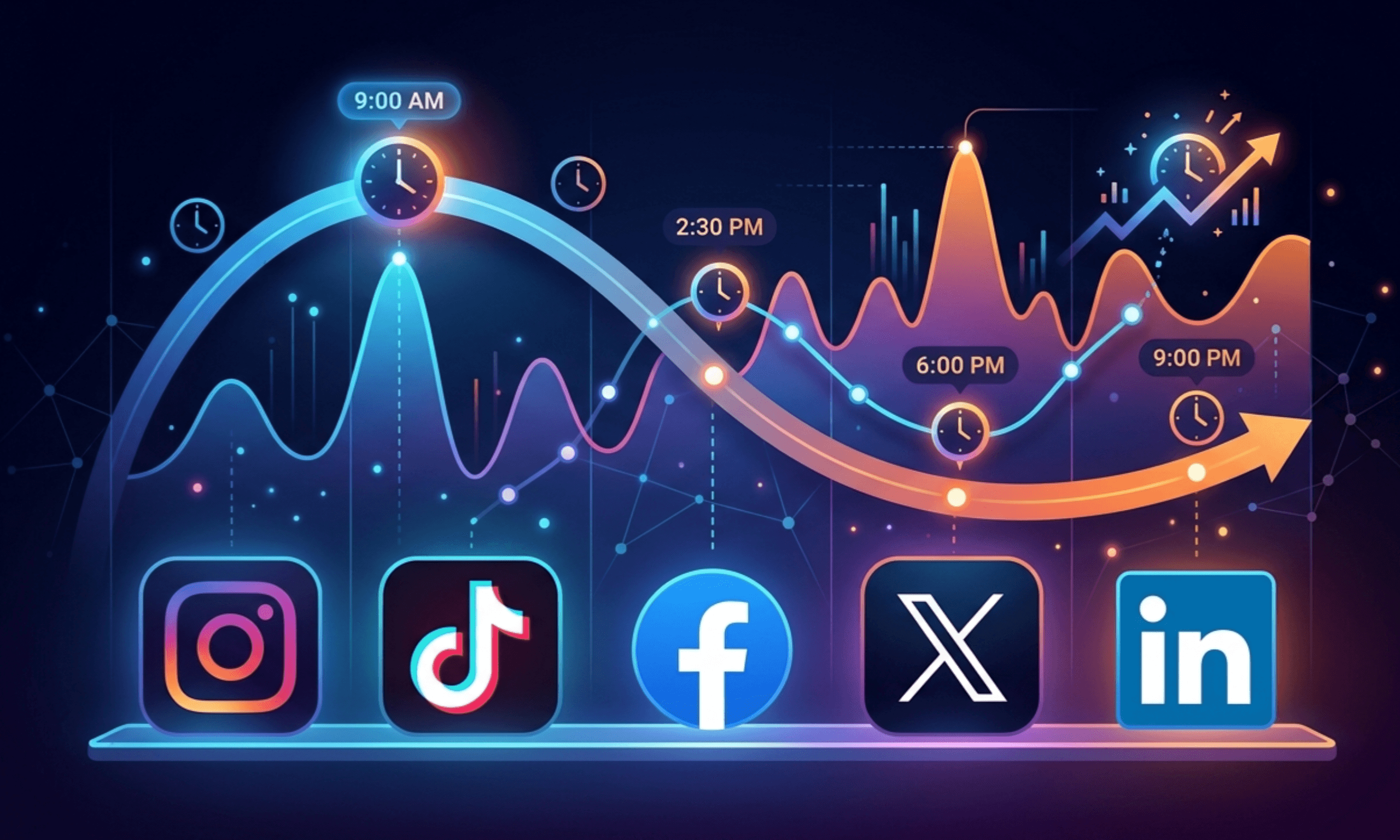
The best time to post on social media in 2026 is not what it was two years ago, and following outdated advice is quietly costing creators reach they never get back. Algorithms across every major platform have shifted how they weight recency, session depth, and early engagement signals, and those changes directly affect when your content gets distributed.
This post breaks down what the latest platform data actually shows for Instagram, TikTok, YouTube, and Facebook, why the shifts happened, and how to use that information to build a posting schedule that works for your specific audience. You will also find a practical method for finding your personal best windows, because no generic chart will beat your own analytics.
Why “Best Times” Keep Shifting
Posting time advice from 2021 or 2022 assumed a world where most users checked their feeds in predictable morning or evening windows. That model no longer holds.
Three things changed the equation significantly.
Short-form video flattened peak hours. Platforms like TikTok and Instagram Reels distribute content well beyond the moment it is posted, meaning a video published at 11 a.m. can reach peak impressions six or twelve hours later. Recency still matters for the initial push, but the distribution window is longer than it used to be.
Algorithm personalization got stronger. In 2026, feeds are deeply individualized. Two users with different viewing habits on the same platform will see the same piece of content at completely different times. Your post does not show up for everyone at once. It gets staged across sessions based on predicted engagement probability.
Remote and hybrid work permanently shifted attention patterns. The classic “commute scroll” at 7–8 a.m. still exists, but midday usage has grown substantially as more people work flexible hours. Late evening slots, once considered dead zones, now compete with prime time on several platforms.
Understanding these three forces helps you stop chasing a universal schedule and start building one rooted in how your specific audience actually behaves.
Instagram: When Early Signals Matter Most
Instagram’s algorithm in 2026 still relies heavily on the velocity of early engagement, meaning the first 30 to 60 minutes after posting are disproportionately important. If your post collects saves, comments, and shares quickly, Instagram interprets that as quality content and pushes it to a broader audience. If it sits quietly, it tends to stay quiet.
The first hour after posting on Instagram functions like a window. Open it with high engagement and the algorithm opens more doors behind it.
Current patterns from aggregated platform data:
- Tuesday, Wednesday, and Thursday mornings between 8 a.m. and 10 a.m. (in your audience’s local timezone) consistently produce strong early engagement across most niches.
- Weekday evenings from 6 p.m. to 8 p.m. remain competitive, especially for lifestyle, food, and entertainment content.
- Sunday afternoons around 1 p.m. to 3 p.m. have gained traction as a secondary window, particularly for educational and motivational content.
What to avoid: Posting between midnight and 6 a.m. or on Friday evenings, when both activity and algorithm distribution tend to dip. Accounts posting at off-peak hours without an established engaged audience rarely recover that initial momentum.
If you are managing a newer account, understanding how Instagram treats new accounts differently from established ones helps explain why timing feels even more critical when you are just starting out. New accounts have less algorithmic history to draw on, so landing your posts in active windows matters more, not less.
TikTok: Riding the For You Page Window
TikTok operates on a fundamentally different distribution logic than Instagram. Rather than relying primarily on follower feeds, TikTok tests content in small batches and expands reach based on completion rates, replays, and shares. This means timing influences your entry into that testing cycle, not the ceiling of your reach.
What current data suggests for TikTok in 2026:
- Morning slots from 7 a.m. to 9 a.m. show strong performance, especially for motivational, productivity, and business content. Audiences in these niches tend to front-load their TikTok sessions before starting work.
- Afternoon windows between 12 p.m. and 2 p.m. catch lunch-hour scrolling and have strong completion rates for shorter videos under 30 seconds.
- Evening sessions from 7 p.m. to 10 p.m. remain the most competitive overall, with entertainment, fashion, and food content performing especially well.
One important nuance: TikTok’s algorithm is genuinely global. If your content gets traction internationally, the concept of a single “best time” matters less than consistent posting and strong hook writing. Still, if your audience is primarily in one region, aligning with their peak hours gives your initial batch a better starting position.
Posting consistency signals to TikTok that you are an active creator worth distributing. Irregular posting, especially disappearing for weeks at a time, tends to reset whatever momentum you have built.
YouTube: Upload Windows and the Search Traffic Layer
YouTube works differently from every other platform on this list because it has two distinct distribution modes: algorithmic recommendation and search. Timing primarily affects the recommendation side, which includes your subscribers’ feeds, the home page, and suggested videos.
Search traffic, on the other hand, is largely time-agnostic. A well-optimized video on a popular topic will accumulate views over months or years regardless of when it was uploaded.
For subscriber and recommendation-driven content:
- Thursday and Friday uploads between 2 p.m. and 4 p.m. tend to perform well because they catch viewers building momentum into the weekend.
- Saturday mornings around 9 a.m. to 11 a.m. work well for longer content, tutorials, and entertainment, as viewers have more time and lower pressure to stop watching.
- Sunday evenings from 5 p.m. to 8 p.m. are effective for educational channels and personal finance content.
For evergreen content, the upload time matters less than the title, thumbnail, and early watch time. If your video holds viewers through the first 30 seconds, YouTube will test it regardless of when it was posted.
Facebook: The Comeback Platform With New Timing Rules
Facebook’s relevance in 2026 is often underestimated. While it skews older than TikTok or Instagram in most markets, it remains one of the highest-engagement platforms for local businesses, communities, and certain content verticals including parenting, home improvement, and political commentary.
Facebook’s algorithm in 2026 heavily prioritizes content that generates comments and shares rather than passive likes or views. That distinction changes how timing matters.
Best windows for Facebook posts in 2026:
- Tuesday through Thursday from 9 a.m. to 1 p.m. consistently shows strong reach for business and educational content. This window aligns with when many Facebook users check their feeds during work breaks.
- Wednesday at 11 a.m. appears repeatedly in current engagement data as a peak for general content across multiple industries.
- Weekends before noon perform well for community groups and local business pages, as users have more time to comment and share.
What kills Facebook reach now: Low-quality images, posts with links in the caption (move links to the first comment), and content that reads like a broadcast announcement rather than a conversation starter. Facebook rewards posts that make people respond.
LinkedIn: Professional Timing With a Narrow Window
LinkedIn has a tighter peak window than most platforms because its audience is primarily active during professional hours. Weekend posting on LinkedIn generally underperforms, with some exceptions for career development and personal story content.
Current high-performing windows:
- Tuesday, Wednesday, and Thursday mornings from 7 a.m. to 9 a.m. capture decision-makers before their workday fully starts.
- Midday from 12 p.m. to 1 p.m. catches the lunch-hour scroll, which has grown as a LinkedIn usage peak over the past two years.
- Avoid Mondays and Fridays for most professional content. Monday posts compete with high mental load at the start of the week, and Fridays see lower engagement as people wind down.
Content that generates early comments performs significantly better on LinkedIn because the algorithm pushes posts to commenters’ networks, extending reach exponentially. Writing a post designed to invite a response is as important as posting at the right hour.
How to Find Your Own Best Times (And Why You Should)
Every chart in this post is an aggregated average. Your audience is not average.
A fitness creator with a large following in Southeast Asia will see completely different peak windows than a B2B SaaS brand targeting U.S. enterprise buyers. Using generic charts as a starting point is fine, but the data inside your own analytics will always outperform external benchmarks over time.
A simple method to find your personal best windows:
- Export your last 90 days of post performance data. Most platforms provide this inside their native analytics. Look at reach, saves, and engagement rate, not just raw likes.
- Sort by engagement rate, not total reach. High-reach posts on large accounts can distort the picture. Engagement rate is the cleaner signal.
- Note the day and time for your top 10 to 15 performing posts. Look for patterns. Are Tuesday mornings appearing repeatedly? Are weekend posts consistently lower?
- Run a controlled four-week test. Post at your identified peak windows consistently and compare performance against your baseline.
This process takes about an hour to set up and gives you data that is specifically calibrated to your audience, not someone else’s.
Low engagement is not always a content quality problem. Sometimes it is purely a timing issue, and that is one of the most fixable variables in a posting strategy. That said, if your posts are landing in good windows but still stalling after a small initial burst, it is worth checking whether there are reach-suppression issues at play beyond just timing.
Platform-by-Platform Quick Reference
| Platform | Best Days | Peak Windows | Weakest Times |
|---|---|---|---|
| Tue, Wed, Thu | 8–10 a.m., 6–8 p.m. | Fri evening, midnight–6 a.m. | |
| TikTok | Any (consistency matters more) | 7–9 a.m., 12–2 p.m., 7–10 p.m. | Very early morning |
| YouTube | Thu, Fri, Sat | 2–4 p.m., 9–11 a.m. Sat | Monday morning |
| Tue, Wed, Thu | 9 a.m.–1 p.m. | Weekends (general content) | |
| Tue, Wed, Thu | 7–9 a.m., 12–1 p.m. | Mon, Fri, weekends |
Does Posting Frequency Affect Timing Strategy?
Posting once a week versus every day changes how you approach timing significantly.
If you post infrequently, every post carries more weight, and hitting a strong window matters more. Missing your best window with your one post of the week is a real cost.
If you post multiple times daily, especially on TikTok or Instagram Reels, the pressure on any single time slot is lower. You are spreading your chances across multiple distribution windows. However, flooding your followers’ feeds in a single hour can suppress later posts in the same day, so spreading posts at least three to four hours apart is recommended.
For accounts trying to grow a new presence, building early momentum on a new account is partly about timing, but it is more about the consistency signal you send to the algorithm. Showing up at your best windows regularly tells the platform you are a reliable source of content worth distributing.
FAQ
Readers often ask specific questions about social media timing that go beyond general best-practices lists. Here are answers to some of the most common.
Does time zone matter if I have a global audience?
Yes, but the impact depends on how concentrated your audience is in specific regions. If 70 percent of your followers are in the Eastern U.S., Eastern Time is your anchor. If your audience is genuinely spread across multiple continents, scheduling tools like Later, Buffer, or Meta Business Suite allow you to test posting in two or three different windows and compare results. Most creators with global audiences find that one region drives the majority of early engagement, and optimizing for that region first is the right move.
Should I always post at peak times, or is some off-peak posting strategic?
Off-peak posting can work strategically on platforms with strong search or hashtag discovery, like YouTube or Pinterest, where content resurfaces over time. On algorithm-driven platforms like Instagram and TikTok, consistent off-peak posting without a strong existing audience tends to result in weaker distribution. If you want to test off-peak times, do it occasionally rather than as a primary strategy.
Why does my content sometimes perform well even when I post at bad times?
Several variables can override poor timing: a very strong hook, a trending sound, an unusually shareable format, or the post being picked up by an account with a larger reach. Timing improves your average performance. It does not guarantee every post will fail or succeed.
How often should I recalculate my best posting times?
Every 60 to 90 days is a practical cadence for most creators. Audience behavior shifts seasonally, algorithm updates can change distribution patterns, and your own content mix may evolve. A quarterly review keeps your strategy current without becoming a constant distraction.
Does the day of the week matter more than the hour?
On most platforms, the hour tends to have a stronger effect on early engagement than the specific day, though the two interact. Wednesday at 9 a.m. will generally outperform Wednesday at 2 a.m., but a well-timed Sunday post can still beat a mid-week post that goes up during a dead window. Focus on hour first, then layer in day-of-week refinements once you have your timing data.
Conclusion
Posting time is not a magic variable, but it is one of the few levers in your content strategy you can adjust without creating new content. Aligning your schedule with the windows where your audience is active and the algorithm is most responsive gives every post a better starting position.
The platforms covered here all show meaningful differences in when engagement peaks, and those windows have shifted meaningfully since 2022. Instagram rewards early velocity. TikTok tests in waves and rewards completion. YouTube blends recommendation timing with long-tail search. Facebook and LinkedIn operate on professional rhythms that do not follow the same logic as entertainment-first platforms.
Start with the general windows in this post, but commit to pulling your own data within the next 90 days. Your analytics will tell you something more valuable than any benchmark: exactly when your specific audience is most likely to engage. From there, test, track, and refine one variable at a time.
If you are still working to understand why certain posts underperform despite good timing, explore how Instagram Reels sometimes stall after early views as a next step. Timing and distribution mechanics work together, and addressing both gives your content the best possible chance.