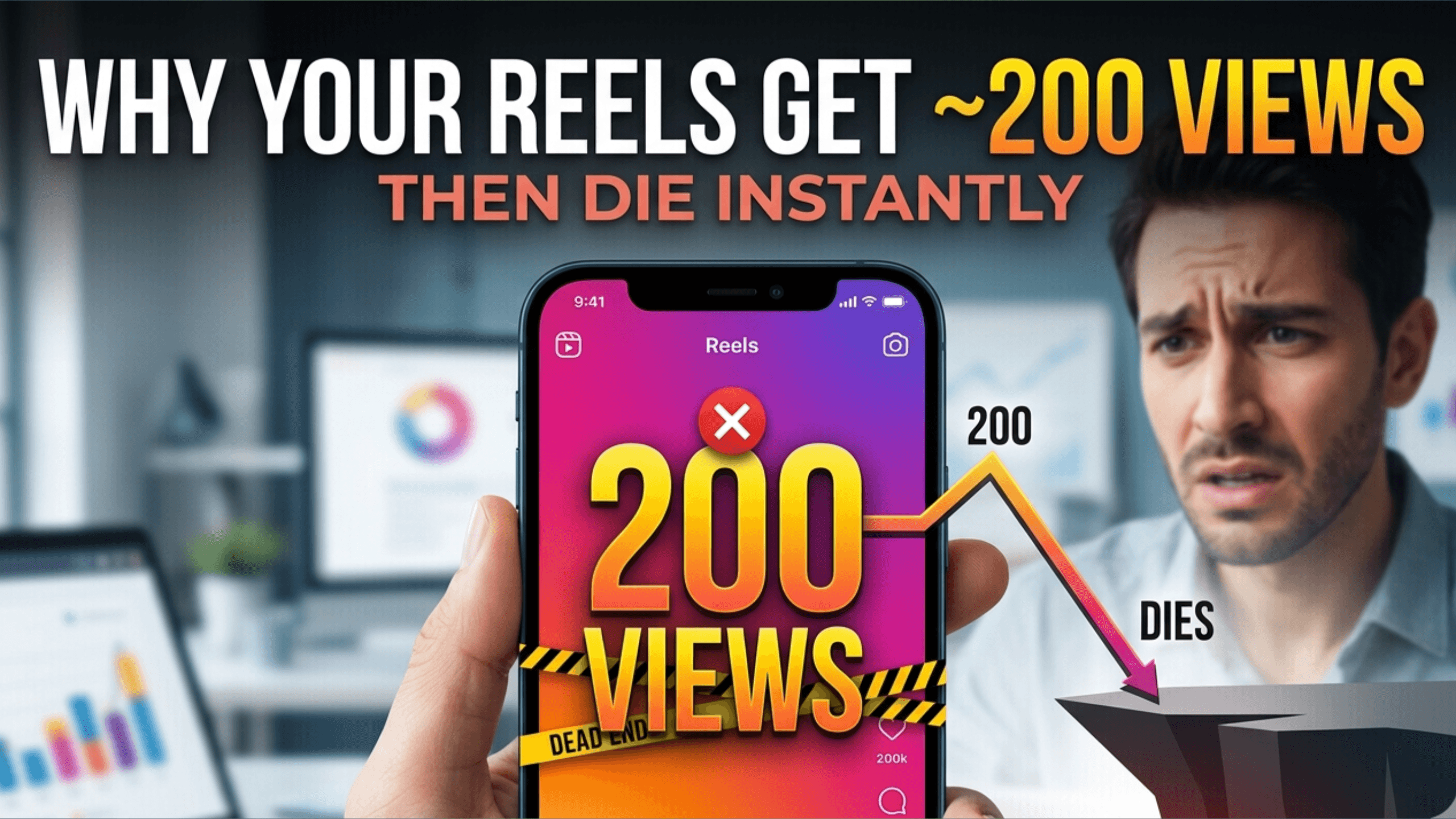
Your Reel hits 200 views, then stops completely. No growth, no shares, no new followers. Most creators assume Instagram is suppressing them. The real answer is simpler and more fixable: your Reel failed a distribution test before most people ever saw it.
This post breaks down exactly how Instagram’s initial scoring system works, why Reels stall at that ~200-view mark, and what you can do differently starting with your next upload.
The 200-View Plateau Isn’t Random
Instagram does not distribute Reels to your full audience immediately. According to widely reported findings from creators and social media analysts, the platform pushes each new Reel to a small test batch — typically between 100 and 300 users. Based on how that group responds in the first few hours, Instagram’s algorithm decides whether to expand distribution or stop it entirely.
Think of it as a gate, not a punishment. Your content is being scored before it earns wider reach. If the test batch scrolls past quickly, drops off early, or ignores it — the Reel dies there.
Key point: You’re not shadowbanned. You failed the first test.
This distinction matters. Shadowban thinking leads creators to change posting times, clear caches, or take breaks. None of that addresses the actual problem: the content didn’t hold attention long enough to earn the next push.
How Instagram Decides to Push or Kill Your Reel
Instagram’s algorithm evaluates several behavioral signals from that initial test audience. Widely reported by creators and platform analysts, here’s how those signals appear to be weighted:
| Signal | Why It Matters |
|---|---|
| Watch time / retention | Did viewers watch past 3 seconds? Did they finish? |
| Replays / loops | Rewatching is one of the strongest signals for short-form content |
| Saves | Indicates high perceived value — widely considered the top engagement signal |
| Shares | Extends reach organically; strong distribution signal |
| Comments | Shows active engagement, not passive viewing |
| Likes | Weakest signal — easiest to give, least predictive of real interest |
| Scroll speed | A fast swipe away registers as a negative signal |
Retention is king. A Reel with 80% watch time and zero likes will outperform one with 50 likes and 40% watch time. Likes feel good but don’t move the algorithm meaningfully on their own.
The Real Reasons Your Reel Stops at 200 Views
Most Reels don’t fail because of bad luck or a small account. They fail because of specific, fixable content problems. Here are the five most common causes.
A. Weak First 1–2 Seconds
Viewers decide whether to keep watching within the first second. If your Reel opens with a logo, a slow pan, or someone talking without context, most people scroll immediately.
That first second needs to do one thing: give viewers a reason to stay. A clear visual hook, a bold text overlay, or an unresolved question all work. A generic intro does not.
B. Poor Retention Curve
Even if your hook lands, a slow middle kills distribution. Instagram’s algorithm monitors where viewers drop off. A significant drop at the 5-second or 10-second mark signals weak pacing — and the algorithm responds by pulling back reach.
Cut anything that doesn’t move the content forward. Dead space, repeated points, and slow transitions all damage your retention curve.
C. No Rewatch Value
Loops and replays are a strong positive signal for short-form content. If your Reel ends cleanly with no reason to rewatch, you lose that signal entirely.
Content that rewards rewatching includes: subtle details viewers miss the first time, a seamless loop where the ending connects back to the beginning, or a payoff that lands better on second viewing.
D. Content Misalignment
Instagram’s algorithm distributes content based on topical and behavioral signals. If your account posts inconsistently across unrelated niches, the algorithm has no reliable audience to test your Reel with.
Inconsistent niche = confused distribution. The algorithm doesn’t know who to show your content to, so it shows it to fewer people.
E. Low Shareability
Shares are one of the highest-value signals in Reels distribution. If viewers don’t feel compelled to send your Reel to someone, that signal stays at zero.
Content gets shared when it’s:
- Relatable — “This is exactly me”
- Useful — “I need to save this”
- Surprising — “You have to see this”
If your Reel doesn’t fit at least one of those, shareability will be low regardless of production quality.
The Biggest Misconceptions That Keep Creators Stuck
These four beliefs are extremely common — and all of them redirect your attention away from the actual problem.
“It’s the hashtags.” Hashtag strategy had more impact in Instagram’s earlier years. For Reels in 2025–2026, their influence on distribution is minimal. Optimizing hashtags while ignoring retention is rearranging furniture in a house with a broken foundation.
“I posted at the wrong time.” Posting time affects initial exposure for feed content. For Reels, the algorithm-driven distribution cycle stretches well beyond your posting window. A Reel with strong signals will get pushed regardless of when it was posted.
“My account is too small.” Account size does not determine Reels reach the way it once did for organic feed posts. Small accounts break out regularly when their content passes the initial test. The test batch system levels the field — what matters is how that batch responds, not how many followers you have.
“Instagram is suppressing me.” This conclusion requires no diagnosis and produces no solution. In most cases, suppression is not what’s happening. The algorithm simply didn’t get enough signal to justify expanding distribution. That’s a content problem, not a platform conspiracy.
What High-Performing Reels Do Differently
Creators whose Reels consistently pass the initial test share a set of structural habits. These aren’t production tricks — they’re decisions about how the content is built.
- They hook in the first frame. Not the first 3 seconds. The first frame. A pattern interrupt, a bold claim, or an unresolved visual question.
- They cut dead space completely. Every second either moves the content forward or it’s removed. No slow fades, no long pauses, no repeated points.
- They build curiosity loops. They introduce a question or tension early and resolve it late — keeping viewers watching to get the payoff.
- They design the ending to loop. The last frame connects naturally back to the first, making replays feel seamless.
- They feel native, not produced. Overproduced content signals “ad” to viewers. Native-feeling content signals “creator.” Viewers engage differently with each.
Comparison:
| Weak Reel Structure | Strong Reel Structure |
|---|---|
| Opens with logo or music | Opens with visual hook or bold text |
| Explains context first | Drops into the point immediately |
| Ends with a CTA screen | Ends in a way that loops or rewards rewatch |
| Consistent pacing throughout | Pattern change every 2–3 seconds |
| Relies on likes | Designed for saves and shares |
How to Fix the 200-View Problem: A Practical Framework
Apply these five steps before your next upload. Each one addresses a specific signal the algorithm measures.
- Fix the hook. Your first second needs a clear visual element and, ideally, a text overlay that states the value or tension immediately. Don’t build up to the point — start at it.
- Tighten the edit. Watch your Reel back at 1.5x speed. Every moment that feels slow at that speed needs to be cut or compressed. Slightly faster pacing holds attention better than comfortable pacing.
- Design for retention. Add a visual or audio pattern change every 2–3 seconds. This can be a cut, a zoom, a caption appearing, or a sound transition. Each change resets attention and keeps viewers from drifting.
- Add loop mechanics. End your Reel on an open thought, a seamless visual that connects to your opening frame, or a question that gets answered by rewatching. Even a subtle loop increases your replay rate.
- Test for shareability. Before posting, ask: “Would I send this to a specific person right now?” If the answer is no — or if you can’t picture who you’d send it to — rebuild the concept around something more relatable, useful, or surprising.
A Simple Pre-Post Diagnostic Checklist
Run through this before every Reel upload:
- Does the first second give a clear reason to keep watching?
- Would I watch this to the end if it showed up on my feed?
- Is there a pattern change at least every 3 seconds?
- Does the ending encourage a rewatch or loop naturally?
- Would I send this to someone specific?
If two or more answers are “no,” the Reel is likely to stall at ~200 views. Fix the weakest points before posting — not after.
Frequently Asked Questions
Why do some Reels suddenly get views days after posting?
Occasionally, a piece of external engagement — a share, a comment from a larger account, or a sudden increase in saves — can re-trigger Instagram’s distribution algorithm. The platform periodically re-evaluates content that receives new engagement signals. This is rare, but it does happen. It’s not a strategy to count on, but it explains why some older Reels occasionally spike.
Does posting frequency affect Reel reach?
Posting more often does not directly increase reach per Reel. However, posting consistently within a defined niche helps Instagram build a clearer behavioral profile of your audience — which improves the accuracy of your test batch. Creators who post irregularly across different topics tend to see weaker initial distribution because the algorithm has less data on who to target.
Can boosting a Reel with paid promotion help it break out organically?
Boosting increases paid impressions but does not directly influence the organic distribution algorithm. Widely reported creator experience suggests that paid reach and organic reach are measured separately. Boosting a weak Reel gives it more views — but if those paid viewers don’t engage, the organic signals remain poor.
Why does a Reel with fewer followers sometimes outperform one from a large account?
The initial test batch is distributed based on content relevance signals, not follower count. A highly niche, high-retention Reel from a small account can pass the test more effectively than a broad, low-retention Reel from a large one. The algorithm optimizes for engagement rate within the test group, not absolute numbers.
Is there an ideal Reel length for passing the initial test?
No single length guarantees distribution. However, creators and analysts widely report that Reels between 7 and 15 seconds tend to achieve higher completion rates, which strengthens the retention signal. Longer Reels (30–60 seconds) can perform well if pacing is tight, but they carry more risk of mid-video drop-off.
Conclusion
The ~200-view stall is not Instagram hiding your content. It’s the algorithm doing exactly what it’s designed to do: stopping content that didn’t earn a wider audience in the initial test.
The signals that decide your Reel’s fate — retention, replays, saves, shares — are all shaped by decisions you make before you hit post. A stronger hook, tighter editing, and content built for shareability directly improve those signals.
Use the diagnostic checklist on your next Reel before it goes live. One focused revision to your hook or edit can be the difference between 200 views and 20,000.